Frequency coordination
Frequency coordination is planning the frequencies of every radio device at an event so that mics, in-ear monitors and other wireless gear do not interfere with each other.
Why different frequencies are not enough
With two or three radio mics the receiver's automatic scan copes: it finds free slots and the technician syncs the transmitters. With ten or more channels a new problem appears. Transmitters working at the same time mix and create new, weak signals on other frequencies. This is called intermodulation. If one of these by-products lands on another mic's frequency, that mic crackles or drops out, even though every mic is on a different frequency.
The number of such combinations grows quickly with every extra transmitter. That is why the frequencies for a large event are calculated with software that picks channels so that neither they nor their by-products get in each other's way. In-ear monitors, intercom and camera radio links have to go into the same plan.
How the technician coordinates
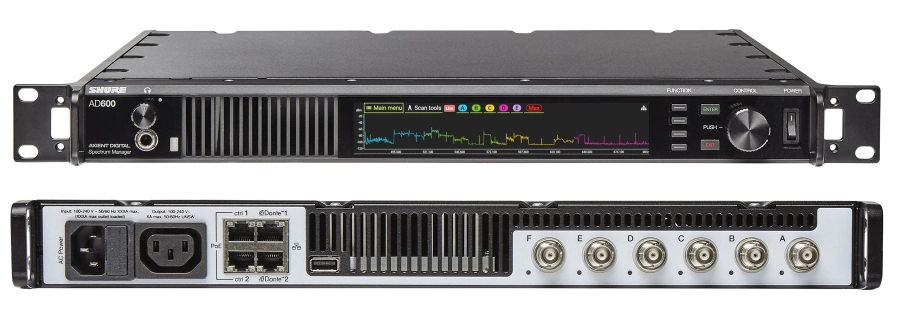
First the technician scans the airwaves at the venue to see what is occupied. Then they calculate a plan of compatible frequencies, keep a couple of free spares in reserve and set up each transmitter and receiver. In large systems the Shure AD600 spectrum manager helps: it watches the airwaves continuously and flags when a frequency becomes noisy.
At a festival or a multi-stage event, frequencies are coordinated across all stages, because radio waves ignore stage boundaries. The same applies to a hotel or conference centre with other events in neighbouring halls.
What the organiser has to do
The organiser does not have to calculate frequencies, but holds information without which the technician cannot make a good plan.
- Make a list of every radio device: rented mics, the performers' and bands' own systems, in-ear monitors, intercom, video crew links.
- Ask the venue which radio systems already run there and what happens in neighbouring halls at the same time.
- Leave enough time for the sound check so the technician can scan and test every channel before the audience arrives.
- Mistake: a performer brings their own radio mic at the last minute. A stray transmitter can interfere with other channels too, so show it to the technician first.
- Mistake: assuming two systems from different makers simply know about each other. They have to be coordinated together.